
What You Need to Know About Feed Conversion Ratio for Profitable Fish Farming

Posted on: 2025-11-04
By: Yomi Adisa
You've invested months raising healthy fish, only to discover your feed costs are eating away at your profits. Every kilogram of feed you pour into your ponds should translate into profitable fish weight—but without understanding Feed Conversion Ratio (FCR), you're essentially farming blind.
FCR is the mathematical relationship between how much feed you use and how much fish weight you gain. A catfish farmer in Lagos recently discovered his FCR was 2.8 when it should have been 1.8—meaning he was spending 1,000 naira extra on feed for every kilogram of fish produced. Over 500 fish, that's half a million naira in unnecessary costs.
In this comprehensive guide, you'll learn exactly what FCR means for your bottom line, how to calculate it accurately, and which factors influence whether you're operating at peak efficiency or haemorrhaging money through poor feed conversion. You'll discover the specific FCR ranges for tilapia and catfish in African conditions, understand how water quality and feeding techniques directly impact your feed costs, and see real examples from successful farms across Nigeria and Ghana.
Most importantly, you'll understand why FCR isn't just a technical measurement—it's the difference between a profitable fish farming business and one that struggles to break even. When you finish reading, you'll know exactly what your target FCR should be and what steps to take if you're falling short.
What You Will Learn
- How to calculate Feed Conversion Ratio (FCR) accurately and its significance for profitability.
- Factors influencing FCR and how to optimise them for better feed efficiency.
- The impact of feed quality on FCR and practical indicators for assessing feed performance.
- Strategies for improving FCR through feeding practices and environmental management.
- Real-world examples of successful FCR optimisation and the financial benefits realised by farmers.
What is Feed Conversion Ratio (FCR)?
Feed Conversion Ratio represents the efficiency of your fish farming operation in the most direct way possible. You need to understand this metric because it determines whether your feed investment translates into profitable fish or disappears into waste. Every successful fish farmer in Africa tracks FCR religiously—it's the difference between making money and losing it.
Most farmers focus on fish growth without connecting it to feed costs, but FCR bridges that gap completely. When you understand your FCR, you can predict exactly how much feed you'll need to produce a specific weight of fish. This knowledge allows you to budget accurately, price your fish correctly, and identify problems before they destroy your profits.
Definition of Feed Conversion Ratio
Feed Conversion Ratio measures how efficiently your fish convert feed into body weight. You calculate it by dividing the total amount of feed consumed by the total weight gained by your fish. An FCR of 1.5 means your fish need 1.5 kilograms of feed to gain 1 kilogram of body weight.
This ratio tells you immediately whether your operation is efficient or wasteful. Lower FCR numbers indicate better efficiency—your fish are converting more feed into flesh rather than waste. Higher FCR numbers signal problems that are costing you money with every feeding.
Consider this practical example: if you feed 150kg of pellets to your fish and they gain 100kg in total weight, your FCR is 1.5 (150÷100=1.5). This is excellent efficiency for most species. However, if the same 150kg of feed only produces 75kg of fish weight gain, your FCR jumps to 2.0—meaning you're spending 33% more on feed for the same results.
Importance of FCR in Aquaculture
FCR directly impacts your profitability because feed typically represents 60-70% of your total production costs in African fish farming. When your FCR improves from 2.0 to 1.6, you're reducing feed costs by 20% while maintaining the same fish production. For a farmer producing 1,000kg of fish monthly, this improvement saves approximately ₦80,000 in feed costs.
You need to monitor FCR because it reveals problems before they become disasters. Rising FCR often indicates disease, poor water quality, or inferior feed quality—all issues that will devastate your profits if left unchecked. Understanding disease prevention strategies becomes crucial when your FCR starts climbing unexpectedly.
Why FCR Matters to Your Bottom Line
- Feed costs: Every 0.1 improvement in FCR reduces feed expenses by approximately 5-6%
- Production planning: Accurate FCR allows precise feed budgeting and harvest timing
- Problem detection: Sudden FCR changes signal health, water quality, or feed issues immediately
- Profitability comparison: FCR lets you compare efficiency across different ponds, species, or seasons
Formula for Calculating FCR
The FCR calculation is straightforward: **FCR = Total Feed Fed (kg) ÷ Total Weight Gain (kg)**. You need accurate records of both feed consumption and fish weight changes to calculate this correctly. Most farmers weigh a sample of fish at stocking and again at harvest, then extrapolate to calculate total weight gain.
Here's a practical example from a tilapia farm in Kumasi: You stock 1,000 fingerlings weighing 50g each (total initial weight: 50kg). After 6 months, you harvest 950 fish averaging 400g each (total final weight: 380kg). Your total weight gain is 330kg (380kg - 50kg). If you used 450kg of feed during this period, your FCR is 1.36 (450÷330=1.36).
You must account for fish mortality in your calculations to get accurate FCR figures. If 50 fish died during the growing period, you need to estimate their weight at death and subtract this from your total weight gain calculation. This ensures your FCR reflects the actual efficiency of feed conversion rather than being skewed by losses.
| Parameter | Example Values | Calculation |
|---|---|---|
| Initial fish weight | 50kg (1,000 × 50g) | Count × average weight |
| Final fish weight | 380kg (950 × 400g) | Survivors × harvest weight |
| Total weight gain | 330kg | Final - Initial weight |
| Total feed used | 450kg | Sum of all feed additions |
| FCR Result | 1.36 | 450kg ÷ 330kg |
Factors Influencing Feed Conversion Ratio
Your FCR doesn't exist in isolation—it's influenced by multiple factors that you can control and optimise. Understanding these factors means you can predict when your FCR might deteriorate and take corrective action before it impacts your profits. The difference between farmers achieving FCR of 1.5 versus 2.5 often comes down to managing these specific variables effectively.
Most farmers blame poor FCR on "bad feed" without realising that species choice, environmental conditions, and feeding practices play equally important roles. You need to understand how each factor affects your feed conversion because addressing the wrong issue wastes time and money while your FCR continues to drain your profits.
The key insight is that FCR improvement requires a systematic approach—you can't just change one factor and expect dramatic results. However, when you optimise multiple factors simultaneously, the cumulative effect can transform your operation from barely profitable to highly successful.
Species-Specific FCR Variations
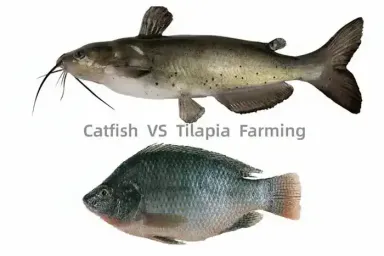
Different fish species have vastly different feed conversion capabilities, and choosing the wrong species for your market can doom your profitability from the start. Tilapia typically achieves FCR between 1.2-1.8 under good conditions, while catfish ranges from 1.5-2.2, and carp can reach 1.8-2.5. These differences aren't just academic—they directly determine your feed costs and profit margins.
You need to match species selection to your local market demands and production capabilities. A tilapia farmer in Accra might achieve excellent FCR of 1.4, but if local buyers prefer catfish and pay 200 cedis more per kilogram, the catfish farmer with FCR of 1.8 still makes more profit. Your species choice must balance biological efficiency with market reality.
Consider the practical implications: producing 1,000kg of tilapia with FCR 1.4 requires 1,400kg of feed, while the same weight of catfish at FCR 1.8 needs 1,800kg of feed. If feed costs ₦300 per kilogram, the catfish farmer spends ₦120,000 more on feed. However, if catfish sells for ₦200 more per kilogram than tilapia, the catfish farmer still nets ₦80,000 more profit despite the higher feed costs.
| Species | Typical FCR Range | Feed Cost per 1000kg Fish | Growth Period |
|---|---|---|---|
| Tilapia | 1.2 - 1.8 | ₦360,000 - ₦540,000 | 5-7 months |
| Catfish | 1.5 - 2.2 | ₦450,000 - ₦660,000 | 4-6 months |
| Carp | 1.8 - 2.5 | ₦540,000 - ₦750,000 | 6-8 months |
Feed Quality and Composition
Feed quality directly determines how efficiently your fish convert nutrients into body weight, yet many African farmers choose feed based solely on price rather than nutritional value. Poor quality feed with inadequate protein content, rancid oils, or inappropriate pellet size can increase your FCR by 30-50%, completely negating any savings from buying cheaper feed.
You need to evaluate feed based on protein content, digestibility, and pellet quality rather than just cost per bag. A 32% protein feed costing ₦8,000 per 25kg bag might deliver better FCR than a 28% protein feed at ₦6,500 per bag. The higher protein feed could reduce your FCR from 2.0 to 1.6, saving you ₦100,000 in feed costs over a 1,000kg production cycle despite the higher upfront cost.
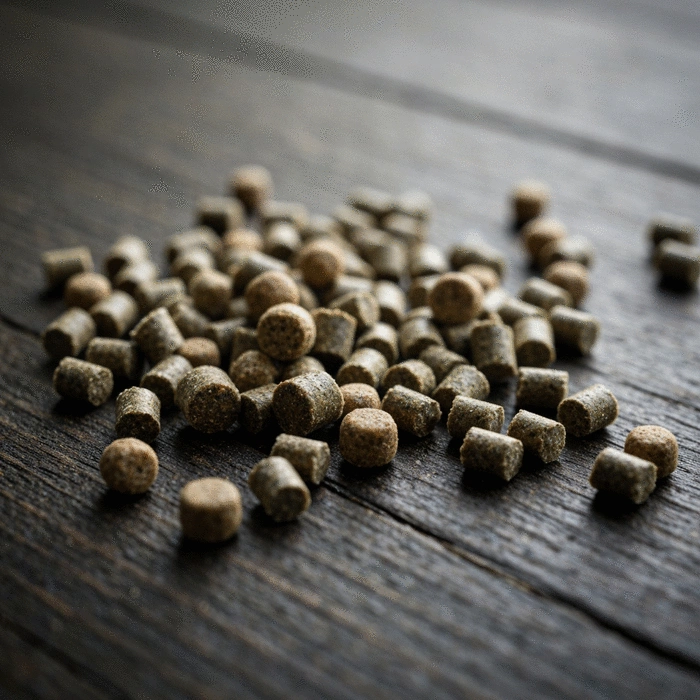
Pellet quality affects FCR because poorly manufactured pellets dissolve quickly in water, creating waste rather than nutrition. Extruded pellets typically deliver better FCR than pelleted feeds because they maintain their structure longer and have better digestibility. Proper water quality management becomes essential when using high-quality feeds to maximise their efficiency.
Feed Quality Indicators That Affect FCR
- Protein content: Higher quality protein sources improve digestibility and reduce FCR
- Pellet stability: Pellets that dissolve quickly waste nutrients and increase FCR
- Oil quality: Rancid oils reduce palatability and nutrient absorption
- Particle size: Inappropriate pellet size reduces feeding efficiency and increases waste
- Storage conditions: Poorly stored feed loses nutritional value and increases FCR
Environmental Conditions
Water quality parameters directly influence your fish's ability to digest feed efficiently, making environmental management crucial for optimal FCR. Poor water quality forces fish to expend energy on stress responses rather than growth, immediately increasing your FCR and feed costs. You can have the best feed and perfect feeding schedule, but if your water quality is poor, your FCR will suffer.
Temperature affects FCR more than most farmers realise because fish are cold-blooded and their metabolism changes with water temperature. Catfish achieve optimal FCR at 26-30°C, while tilapia prefer 25-28°C. When water temperature drops below optimal ranges, fish metabolism slows and FCR increases. A 5°C temperature drop can increase FCR by 20-30%, significantly impacting your feed costs.
Stocking density creates a direct trade-off between production volume and feed efficiency. Higher stocking densities increase competition for feed and oxygen, typically worsening FCR. You might produce more total fish weight per pond, but each fish requires more feed to reach market size. A pond stocked at 50 fish per cubic metre might achieve FCR of 1.6, while the same pond at 80 fish per cubic metre could see FCR rise to 2.1, increasing feed costs by 31% per kilogram of fish produced.
Dissolved oxygen levels below 5mg/L immediately impact FCR because fish cannot efficiently digest feed when struggling for oxygen. You'll notice fish gasping at the surface, reduced feeding activity, and steadily climbing FCR. Installing aeration can improve FCR by 0.2-0.4 points, easily justifying the equipment cost through reduced feed expenses.
Benefits of Optimising Feed Conversion Ratio
When you optimise your FCR, you're not just improving a technical metric—you're transforming your entire fish farming operation from a struggle to survive into a profitable business. The benefits extend far beyond simple feed savings, touching every aspect of your operation from cash flow to environmental impact. Most farmers underestimate how dramatically FCR improvements can change their bottom line until they experience it firsthand.
You need to understand that FCR optimisation creates a compounding effect throughout your operation. Better feed conversion leads to faster growth, which means earlier harvests, which improves cash flow, which allows you to invest in better equipment and feed. This positive cycle separates successful farms from those that remain stuck in survival mode year after year.
The most successful fish farmers in Africa treat FCR optimisation as their primary competitive advantage. While other farmers compete on price alone, these operators compete on efficiency, allowing them to maintain healthy profit margins even when market prices fluctuate. When you achieve consistently low FCR, you gain the flexibility to weather market downturns that destroy less efficient operations.
Economic Advantages of a Low FCR
Every 0.1 improvement in your FCR translates directly into 5-6% reduction in feed costs, and since feed represents 60-70% of your total production expenses, these savings accumulate rapidly. A catfish farmer producing 2,000kg monthly who improves FCR from 2.0 to 1.7 saves approximately ₦180,000 per month in feed costs alone. Over a full year, this single improvement generates over ₦2 million in additional profit.
You gain pricing flexibility when your FCR is optimised because your production costs are lower than competitors. When market prices drop, farmers with poor FCR are forced to sell at losses or hold fish longer, increasing their costs further. However, with excellent FCR, you can maintain profitability even during price downturns, allowing you to capture market opportunities when other farmers retreat.
Consider this real scenario: two catfish farmers in Oyo State both produce 1,000kg monthly. Farmer A achieves FCR of 1.6, while Farmer B struggles with FCR of 2.3. At current feed prices of ₦320 per kilogram, Farmer A spends ₦512,000 on feed monthly, while Farmer B spends ₦736,000. This ₦224,000 monthly difference means Farmer A can afford to sell fish ₦224 per kilogram cheaper than Farmer B while maintaining the same profit margin.
| FCR Level | Feed Cost per 1000kg Fish | Monthly Savings vs FCR 2.5 | Annual Profit Impact |
|---|---|---|---|
| 1.5 (Excellent) | ₦480,000 | ₦320,000 | ₦3,840,000 |
| 1.8 (Good) | ₦576,000 | ₦224,000 | ₦2,688,000 |
| 2.2 (Average) | ₦704,000 | ₦96,000 | ₦1,152,000 |
| 2.5 (Poor) | ₦800,000 | ₦0 | ₦0 |
Environmental Sustainability
Optimised FCR reduces the environmental impact of your fish farming operation by minimising waste production and nutrient pollution. When your fish convert feed efficiently, less uneaten feed accumulates in pond bottoms, reducing water quality problems and the need for frequent water changes. This efficiency translates into lower operational costs and reduced environmental stress on your local water sources.
You contribute to sustainable aquaculture practices when you achieve low FCR because efficient operations require fewer natural resources per kilogram of fish produced. Better feed conversion means less pressure on fishmeal and agricultural inputs used in feed manufacturing, supporting the long-term sustainability of the entire aquaculture industry. This becomes increasingly important as African fish farming expands and competes for limited feed ingredients.
Efficient FCR also reduces your carbon footprint because feed production and transportation represent significant energy inputs in aquaculture. A farmer achieving FCR of 1.5 instead of 2.2 reduces feed requirements by 32%, directly cutting the environmental cost of feed production and transport. This efficiency becomes a competitive advantage as consumers and buyers increasingly value environmentally responsible production methods.
Environmental Benefits of FCR Optimisation
- Reduced waste: Less uneaten feed means cleaner water and healthier pond ecosystems
- Lower resource use: Efficient conversion reduces pressure on feed ingredient sources
- Decreased pollution: Better FCR reduces nutrient runoff and water quality problems
- Carbon footprint: Lower feed requirements reduce transportation and production emissions
- Water conservation: Cleaner ponds require fewer water changes and treatments
Improved Fish Health and Growth Rates
Fish achieving optimal FCR are typically healthier because efficient feed conversion indicates proper nutrition absorption and minimal stress. Healthy fish grow faster, reach market size sooner, and command better prices due to superior flesh quality and appearance. You'll notice that ponds with excellent FCR also have lower mortality rates, reducing your losses and improving overall profitability.
Better FCR often correlates with improved disease resistance because well-nourished fish have stronger immune systems. A tilapia farmer in Ashanti Region noticed that his ponds with FCR below 1.6 experienced 80% fewer disease outbreaks than ponds with FCR above 2.0. This health advantage reduces medication costs and prevents the devastating losses that can destroy months of work and investment.
Faster growth rates from optimised FCR allow you to harvest fish sooner, improving your cash flow and reducing exposure to market price fluctuations. Fish that reach market size in 5 months instead of 7 months free up pond space for additional production cycles, effectively increasing your annual production capacity without expanding infrastructure. A catfish farmer in Lagos increased his annual production from 2.5 to 3.2 cycles per year by improving FCR from 2.1 to 1.7, generating 28% more revenue from the same pond space.
The quality advantages of efficient FCR extend to market acceptance and pricing. Fish produced with optimal feed conversion typically have better flesh texture, colour, and taste because they've converted nutrients efficiently rather than struggling with poor-quality feed or stressful conditions. Buyers often pay premium prices for fish that demonstrate these quality characteristics, further improving your profitability beyond the direct feed cost savings.
Strategies for Improving Feed Conversion Ratio
Improving your FCR requires a systematic approach that addresses feeding practices, feed quality, and environmental management simultaneously. You cannot achieve dramatic FCR improvements by changing just one factor—success comes from optimising multiple variables in coordination. The most successful farmers develop comprehensive FCR improvement plans that tackle the biggest limiting factors first, then fine-tune secondary factors for maximum efficiency.
Most farmers attempt to improve FCR by switching feed brands without addressing underlying issues like poor water quality or inappropriate feeding schedules. This approach rarely delivers lasting improvements because FCR reflects the entire production system, not just feed quality. You need to identify which factors are limiting your current FCR performance before implementing improvement strategies.
The key to sustainable FCR improvement is understanding that small, consistent changes often deliver better results than dramatic overhauls. A systematic approach allows you to measure the impact of each change, identify what works in your specific conditions, and build upon successful modifications. This methodical process prevents costly mistakes and ensures that improvements are sustainable over multiple production cycles.
Feeding Regimens and Techniques
Your feeding schedule directly impacts FCR because fish digest feed most efficiently when fed appropriate amounts at optimal intervals. Overfeeding wastes expensive feed and pollutes water, while underfeeding slows growth and extends production cycles. You need to match feeding frequency and quantity to your fish species, size, and environmental conditions to achieve optimal feed conversion.
Split feeding—dividing daily feed rations into multiple smaller meals—typically improves FCR by 10-15% compared to single daily feeding. Fish digest smaller meals more completely, reducing waste and improving nutrient absorption. A catfish farmer in Ogun State improved FCR from 1.9 to 1.6 simply by splitting his daily feed ration into three meals instead of one, with no other changes to his operation.
Feed timing affects FCR because fish metabolism varies throughout the day based on temperature and oxygen levels. Early morning and late afternoon feeding often produces better FCR than midday feeding when temperatures peak and oxygen levels drop. You should avoid feeding during the hottest part of the day or when fish show signs of stress, as stressed fish convert feed poorly and waste expensive nutrients.
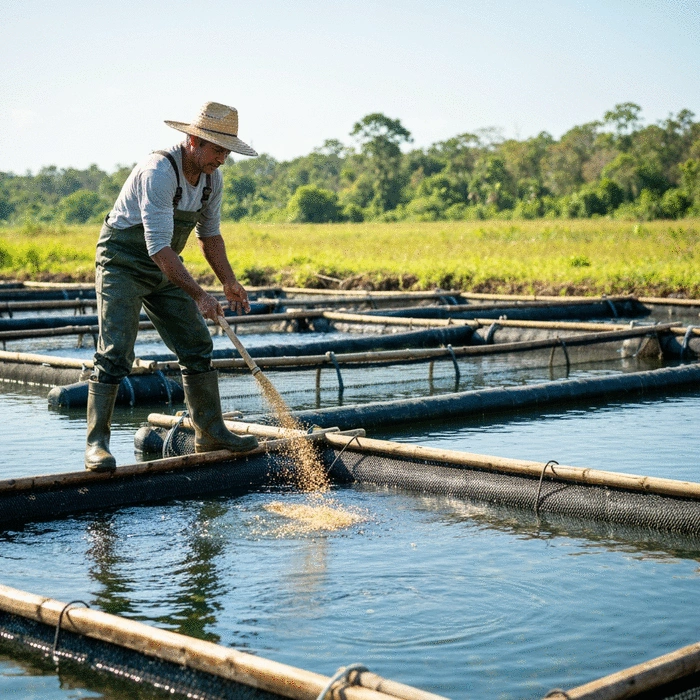
Optimal Feeding Practices for Better FCR
- Feed frequency: 2-3 times daily for fingerlings, 1-2 times for market-size fish
- Feeding rate: 3-5% of body weight for young fish, 1-3% for mature fish
- Timing: Early morning (6-8 AM) and late afternoon (4-6 PM) for best results
- Observation: Stop feeding when fish show reduced interest or feed remains uneaten after 30 minutes
- Weather adjustment: Reduce feeding during cloudy days or when oxygen levels are low
Monitoring and Adjusting Feed Quality
You must evaluate feed quality regularly because even premium feeds can deteriorate during storage, dramatically increasing your FCR. Feed stored in hot, humid conditions loses nutritional value within weeks, while properly stored feed maintains quality for months. A simple storage improvement—keeping feed in sealed containers away from heat and moisture—can prevent FCR increases of 0.3-0.5 points.
Pellet quality assessment should become part of your routine because poor pellets dissolve quickly in water, creating waste instead of nutrition. Quality pellets maintain their shape for at least 30 minutes in water, allowing fish adequate time to consume them. You can test this by dropping pellets in a glass of pond water and timing how long they remain intact—anything less than 20 minutes indicates poor pellet stability that will increase your FCR.
Feed freshness directly impacts palatability and digestibility, both crucial for optimal FCR. Rancid oils in old feed reduce fish appetite and nutrient absorption, while fresh feed encourages active feeding and efficient conversion. You should use feed within 30 days of purchase and store opened bags in cool, dry conditions to maintain quality. Understanding common production challenges helps you identify when feed quality issues are affecting your FCR performance.
| Feed Quality Factor | Good Quality Indicator | Poor Quality Warning | FCR Impact |
|---|---|---|---|
| Pellet stability | Holds shape 30+ minutes | Dissolves within 15 minutes | +0.3 to +0.5 |
| Oil freshness | No rancid smell | Strong fishy odour | +0.2 to +0.4 |
| Storage age | Less than 30 days | Over 60 days old | +0.1 to +0.3 |
| Moisture content | Dry, no clumping | Soft, mouldy patches | +0.4 to +0.8 |
Use of Technology in Feed Management
Automated feeding systems can improve FCR by delivering precise feed quantities at optimal intervals, eliminating human error and ensuring consistency. While the initial investment may seem substantial, the feed savings from improved FCR often justify the cost within 6-12 months. A tilapia farmer in Accra installed automatic feeders costing ₦150,000 and improved his FCR from 1.8 to 1.5, saving ₦200,000 annually in feed costs.
Feed management software helps you track FCR in real-time, allowing immediate adjustments when performance declines. These systems calculate optimal feeding rates based on fish weight, temperature, and growth targets, removing guesswork from feed management. You can identify FCR problems within days rather than weeks, preventing small issues from becoming expensive disasters.
Simple technology solutions often deliver significant FCR improvements at minimal cost. Digital scales for accurate feed measurement, thermometers for temperature monitoring, and basic water testing kits provide the data needed for optimal feeding decisions. A farmer in Ibadan improved FCR from 2.1 to 1.8 by investing ₦25,000 in basic monitoring equipment and following data-driven feeding protocols.
Smartphone apps designed for aquaculture can help you track feeding schedules, record FCR data, and identify trends that affect feed conversion. These tools make it easier to maintain consistent feeding practices and spot problems early. While technology cannot replace good management practices, it can help you implement those practices more consistently and effectively.
Practical Case Studies and Examples
Real-world examples demonstrate how FCR improvements translate into tangible business results for African fish farmers. These case studies reveal the specific strategies that work in African conditions and the financial impact of systematic FCR optimisation. You'll see that successful farmers don't rely on single solutions but implement comprehensive approaches that address multiple factors simultaneously.
The most valuable insights come from farmers who documented their FCR journey, tracking both the changes they made and the financial results they achieved. These detailed records show which improvements delivered the biggest impact and how long it took to see results. Understanding these timelines helps you set realistic expectations and maintain focus during the improvement process.
What separates these successful cases from failed attempts is the systematic approach to problem identification and solution implementation. Rather than making random changes, these farmers identified their biggest FCR limiting factors first, then implemented targeted solutions with careful monitoring. This methodical approach ensures that improvements are sustainable and cost-effective.
Successful Implementation of FCR Improvements
A catfish farmer in Ogun State transformed his operation by focusing on water quality management after discovering that poor dissolved oxygen was his primary FCR limiting factor. His initial FCR of 2.3 was costing him ₦300,000 monthly in excess feed costs compared to the 1.8 FCR achieved by neighbouring farms. By installing paddle wheel aerators and adjusting stocking density, he improved FCR to 1.7 within three months, generating annual savings of ₦2.4 million.
The key to his success was systematic problem identification—he tested water quality parameters daily for two weeks and discovered that dissolved oxygen dropped below 4mg/L every afternoon. Rather than guessing at solutions, he invested ₦180,000 in aeration equipment specifically to address this identified problem. The targeted approach delivered immediate results because it addressed the actual limiting factor rather than symptoms.
A tilapia farmer in Ashanti Region achieved FCR improvement from 1.9 to 1.4 by implementing a comprehensive feeding management system. She divided daily feed rations into three meals, adjusted feeding rates based on water temperature, and switched to higher-quality extruded pellets. The combined approach required six months to show full results but generated ₦1.8 million in annual feed savings on her 2,000kg monthly production.

Success Factors from Case Studies
- Problem identification: Successful farmers identified specific limiting factors before implementing solutions
- Systematic approach: Multiple improvements implemented in logical sequence rather than random changes
- Data tracking: Careful monitoring of FCR changes to measure improvement effectiveness
- Patience: Allowing 2-3 months for full results rather than expecting immediate changes
- Investment mindset: Viewing FCR improvements as profitable investments rather than costs
Cost-Benefit Analysis of FCR Changes
Consider a practical scenario: a 1,000kg monthly catfish operation with FCR of 2.2 spends ₦704,000 monthly on feed at ₦320 per kilogram. Improving FCR to 1.8 reduces monthly feed costs to ₦576,000, saving ₦128,000 monthly or ₦1.54 million annually. If achieving this improvement requires ₦200,000 investment in aeration equipment and better feed, the payback period is less than two months.
The financial impact becomes more dramatic with larger operations. A farmer producing 5,000kg monthly who improves FCR from 2.0 to 1.6 saves ₦640,000 monthly in feed costs. This ₦7.68 million annual saving justifies significant investments in equipment, training, and management systems. The key insight is that FCR improvements generate ongoing savings that compound over time, unlike one-time cost reductions.
You must consider the opportunity cost of poor FCR when evaluating improvement investments. Every month you operate with FCR of 2.2 instead of 1.8 costs you ₦128,000 in a 1,000kg operation. Over a year, this represents ₦1.54 million in lost profits that could fund expansion, equipment upgrades, or emergency reserves. The real question isn't whether you can afford to improve FCR—it's whether you can afford not to improve it.
| Production Scale | FCR Improvement | Monthly Savings | Annual Profit Impact | Investment Payback |
|---|---|---|---|---|
| 500kg monthly | 2.2 to 1.8 | ₦64,000 | ₦768,000 | 3-4 months |
| 1,000kg monthly | 2.2 to 1.8 | ₦128,000 | ₦1,536,000 | 2-3 months |
| 2,000kg monthly | 2.0 to 1.6 | ₦256,000 | ₦3,072,000 | 1-2 months |
| 5,000kg monthly | 2.0 to 1.6 | ₦640,000 | ₦7,680,000 | 1 month |
Lessons Learned from Case Studies
The most important lesson from successful FCR improvement cases is that sustainable results require addressing root causes rather than symptoms. Farmers who achieved lasting improvements identified their specific limiting factors—whether water quality, feed quality, or management practices—before implementing solutions. Those who made random changes without proper diagnosis often saw temporary improvements that didn't last.
Timing matters significantly in FCR improvement efforts because fish respond gradually to management changes. Most successful farmers allowed 2-3 months to evaluate the full impact of modifications before making additional changes. This patience prevented the common mistake of implementing multiple changes simultaneously, making it impossible to identify which modifications actually improved performance.
Documentation proves crucial for sustainable FCR improvement because it allows you to replicate successful practices and avoid repeating mistakes. Farmers who maintained detailed records of feeding schedules, water quality parameters, and FCR results could identify patterns and optimise their operations continuously. Those who relied on memory alone often lost valuable insights and repeated costly errors.
The most successful farmers treated FCR improvement as an ongoing process rather than a one-time project. They established systems for regular monitoring, continuous adjustment, and periodic evaluation of new techniques. This systematic approach allowed them to maintain optimal performance and adapt to changing conditions, ensuring that improvements remained sustainable over multiple production cycles.

Frequently Asked Questions
What is Feed Conversion Ratio (FCR) in fish farming?
FCR is a measure of how efficiently your fish convert feed into body weight. You calculate it by dividing the total amount of feed consumed by the total weight gained by your fish. A lower FCR indicates better efficiency, meaning your fish are converting more feed into flesh rather than waste.
Why is FCR so important for the profitability of my fish farm?
FCR directly impacts your profitability because feed can account for 60-70% of your total production costs. Improving your FCR significantly reduces feed expenses, increases your profit margins, and helps you identify problems like disease or poor water quality before they become major losses.
What factors primarily influence my farm's FCR?
Your FCR is influenced by several factors, including the fish species you're raising, the quality and composition of your feed, and crucial environmental conditions like water temperature, dissolved oxygen levels, and stocking density. Optimising these variables systematically is key to a better FCR.
How can I start improving my farm's FCR?
You should begin by establishing accurate FCR measurement systems, including weighing feed and regularly sampling fish for weight. Then, identify your primary limiting factors through systematic observation and testing of water quality, feed quality, and current feeding practices. Implement high-impact improvements first, allowing 2-3 months to monitor results.
What are the benefits of achieving a low FCR beyond just saving on feed costs?
A low FCR offers numerous benefits, including improved fish health and faster growth rates, leading to earlier harvests and better cash flow. It also contributes to environmental sustainability by reducing waste and resource use, and provides a significant competitive advantage in the market due to lower production costs.
Your journey to profitable fish farming begins with understanding that FCR isn't just a technical measurement—it's the key performance indicator that determines whether your operation thrives or merely survives. Every successful fish farmer in Africa has learned to treat FCR as their primary competitive advantage, using superior feed efficiency to maintain profitability when market conditions challenge less efficient operations.
The evidence from farms across Nigeria, Ghana, and Kenya demonstrates that FCR improvements deliver immediate and lasting financial benefits. When you optimise your feed conversion from 2.2 to 1.8, you're not just saving money on feed—you're transforming your entire business model from price competition to efficiency competition. This shift provides the foundation for sustainable growth and long-term success.
Most importantly, FCR improvement is entirely within your control. Unlike market prices or weather conditions, you can directly influence your feed conversion through better management practices, quality improvements, and systematic monitoring. This control means that your profitability depends on your decisions and actions rather than external factors beyond your influence.
Recap of Key Points
Feed Conversion Ratio represents the efficiency of your entire fish farming operation, directly determining your profitability through its impact on feed costs. With feed representing 60-70% of production expenses, every 0.1 improvement in FCR generates 5-6% reduction in your largest cost category. The difference between FCR of 2.2 and 1.8 can mean ₦1.5 million in annual savings for a 1,000kg monthly operation.
Multiple factors influence your FCR, including species selection, feed quality, environmental conditions, and management practices. You cannot achieve optimal results by addressing just one factor—success requires a systematic approach that optimises water quality, feeding practices, and feed selection simultaneously. The most successful farmers identify their primary limiting factors first, then implement targeted solutions with careful monitoring.
The benefits of FCR optimisation extend beyond direct cost savings to include improved fish health, faster growth rates, environmental sustainability, and competitive advantages. Better FCR allows you to maintain profitability during market downturns, invest in growth opportunities, and build a sustainable business that can weather industry challenges. These advantages compound over time, creating increasing separation between efficient and inefficient operations.
Next Steps for Farmers
Your first priority should be establishing accurate FCR measurement systems in your current operation. You need reliable scales for feed measurement, regular fish sampling for weight tracking, and detailed records of both inputs and outputs. Without accurate baseline data, you cannot identify improvement opportunities or measure the success of changes you implement.
Begin FCR improvement by identifying your primary limiting factors through systematic observation and testing. Check water quality parameters daily for two weeks, evaluate your current feed quality and storage practices, and assess your feeding schedules and techniques. This diagnostic phase prevents wasted effort on solutions that don't address your actual problems.
Implement improvements systematically, focusing on the factors with the greatest potential impact first. If water quality is your primary limitation, invest in aeration or pond management before changing feed brands. If feed quality is the issue, improve storage and sourcing before adjusting feeding schedules. Allow 2-3 months to evaluate each major change before implementing additional modifications.
Immediate Action Steps
- Week 1: Establish accurate weighing and record-keeping systems for FCR calculation
- Week 2-3: Conduct comprehensive assessment of water quality, feed quality, and current practices
- Month 1: Implement the highest-impact improvement identified in your assessment
- Month 2-3: Monitor results and fine-tune the initial improvement before adding new changes
- Month 4: Evaluate overall progress and plan the next phase of improvements
Encouragement for Continuous Learning
FCR optimisation is a journey of continuous improvement rather than a destination you reach and maintain effortlessly. Successful farmers treat each production cycle as an opportunity to refine their practices, test new approaches, and build upon previous successes. This mindset of ongoing learning and adaptation separates thriving operations from those that plateau at mediocre performance levels.
The fish farming industry in Africa is rapidly evolving, with new feed formulations, management techniques, and technologies becoming available regularly. You need to stay informed about these developments and evaluate their potential application to your operation. However, always test new approaches on a small scale before implementing major changes across your entire operation.
Connect with other successful farmers in your region to share experiences and learn from their FCR improvement journeys. Local farmer associations, agricultural extension services, and online communities provide valuable resources for ongoing education and problem-solving. The most successful farmers actively seek out new knowledge and aren't afraid to adapt their practices when better methods become available.
Remember that every challenge you face in FCR improvement has been solved by other farmers in similar conditions. The solutions exist—your job is to identify which approaches work best in your specific situation and implement them systematically. With patience, persistence, and proper measurement, you can achieve the FCR levels that transform fish farming from a struggle into a profitable business that supports your family and community for years to come.
Frequently Asked Questions
What is Feed Conversion Ratio (FCR) in fish farming?
FCR is a measure of how efficiently your fish convert feed into body weight. You calculate it by dividing the total amount of feed consumed by the total weight gained by your fish. A lower FCR indicates better efficiency, meaning your fish are converting more feed into flesh rather than waste.
Why is FCR so important for the profitability of my fish farm?
FCR directly impacts your profitability because feed can account for 60-70% of your total production costs. Improving your FCR significantly reduces feed expenses, increases your profit margins, and helps you identify problems like disease or poor water quality before they become major losses.
What factors primarily influence my farm's FCR?
Your FCR is influenced by several factors, including the fish species you're raising, the quality and composition of your feed, and crucial environmental conditions like water temperature, dissolved oxygen levels, and stocking density. Optimising these variables systematically is key to a better FCR.
How can I start improving my farm's FCR?
You should begin by establishing accurate FCR measurement systems, including weighing feed and regularly sampling fish for weight. Then, identify your primary limiting factors through systematic observation and testing of water quality, feed quality, and current feeding practices. Implement high-impact improvements first, allowing 2-3 months to monitor results.
What are the benefits of achieving a low FCR beyond just saving on feed costs?
A low FCR offers numerous benefits, including improved fish health and faster growth rates, leading to earlier harvests and better cash flow. It also contributes to environmental sustainability by reducing waste and resource use, and provides a significant competitive advantage in the market due to lower production costs.

Yomi Adisa
Yomi Adisa is the lead researcher at Fish Farming Business, where he studies what makes aquaculture ventures profitable across Africa. His research focuses on market patterns, buyer preferences, and the business decisions that determine success or failure in fish farming.